
Thursday, February 22, 2007

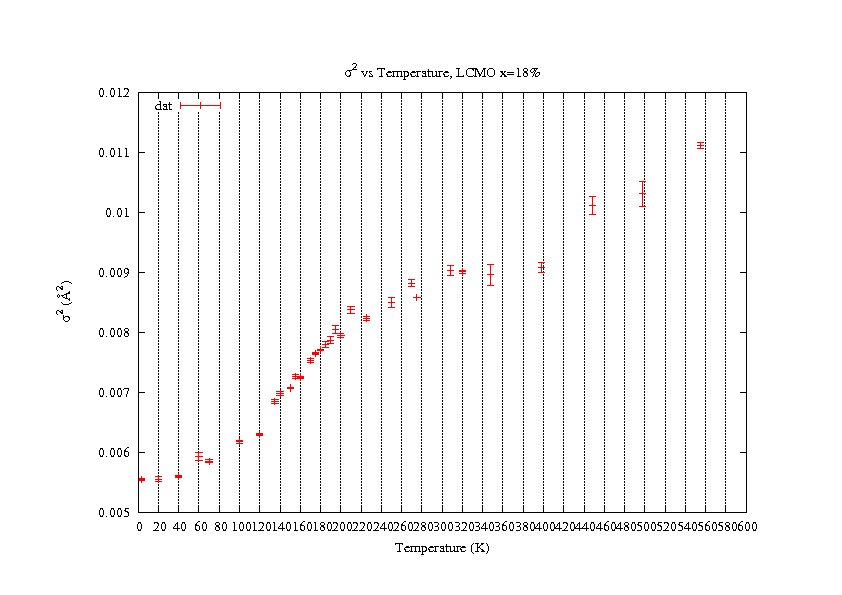

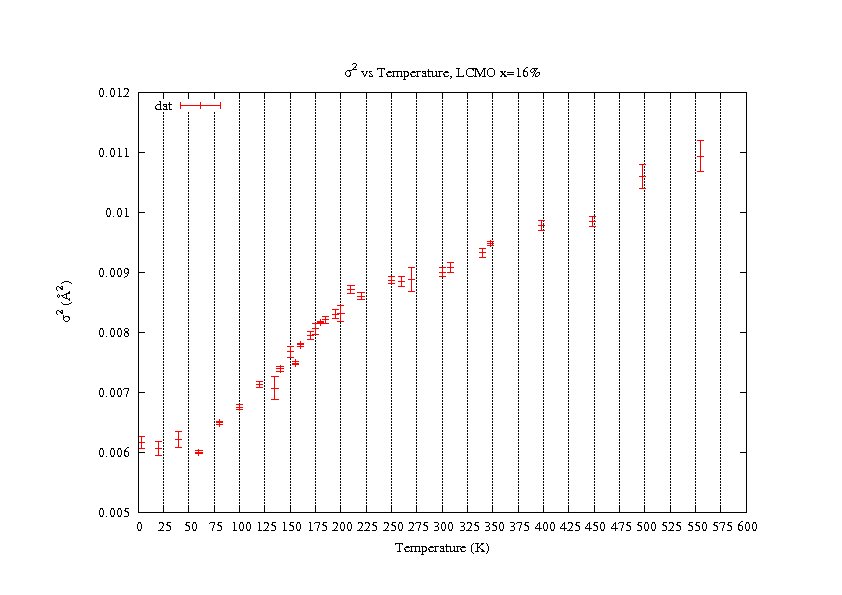

Data points for LCMO (x = 0.16 - 0.22)
| 16% | 18% | 20% | 22% |
| 3 | 3 | 3 | 3 |
| 20 | 20 | 20 | 20 |
| 40 | 40 | 40 | 40 |
| 60 | 60 | 60 | 60 |
| 80 | 70 | 70 | 80 |
| 100 | 100 | 100 | 100 |
| 120 | 120 | 120 | 105 |
| 135 | 135 | 135 | 120 |
| 140 | 140 | 140 | 135 |
| 150 | 150 | 150 | 140 |
| 155 | 155 | 155 | 150 |
| 160 | 160 | 160 | 155 |
| 170 | 170 | 170 | 160 |
| 175 | 175 | 180 | 170 |
| 180 | 180 | 185 | 175 |
| 185 | 185 | 190 | 180 |
| 195 | 190 | 195 | 185 |
| 200 | 195 | 200 | 190 |
| 210 | 200 | 210 | 195 |
| 220 | 210 | 225 | 195 |
| 250 | 225 | 250 | 200 |
| 260 | 250 | 270 | 210 |
| 270 | 270 | 275 | 220 |
| 300 | 275 | 308 | 250 |
| 308 | 308 | 320 | 260 |
| 340 | 320 | 348 | 270 |
| 348 | 348 | 398 | 300 |
| 398 | 398 | 448 | 303 |
| 448 | 448 | 498 | 345 |
| 498 | 498 | 555 | 376 |
| 555 | 555 | 406 | |
| 435 | |||
| 465 | |||
| 495 | |||
| 524 | |||
| 555 |
Wednesday, January 24, 2007
Preliminary results by ananlyzing LCMO (16%-22%)
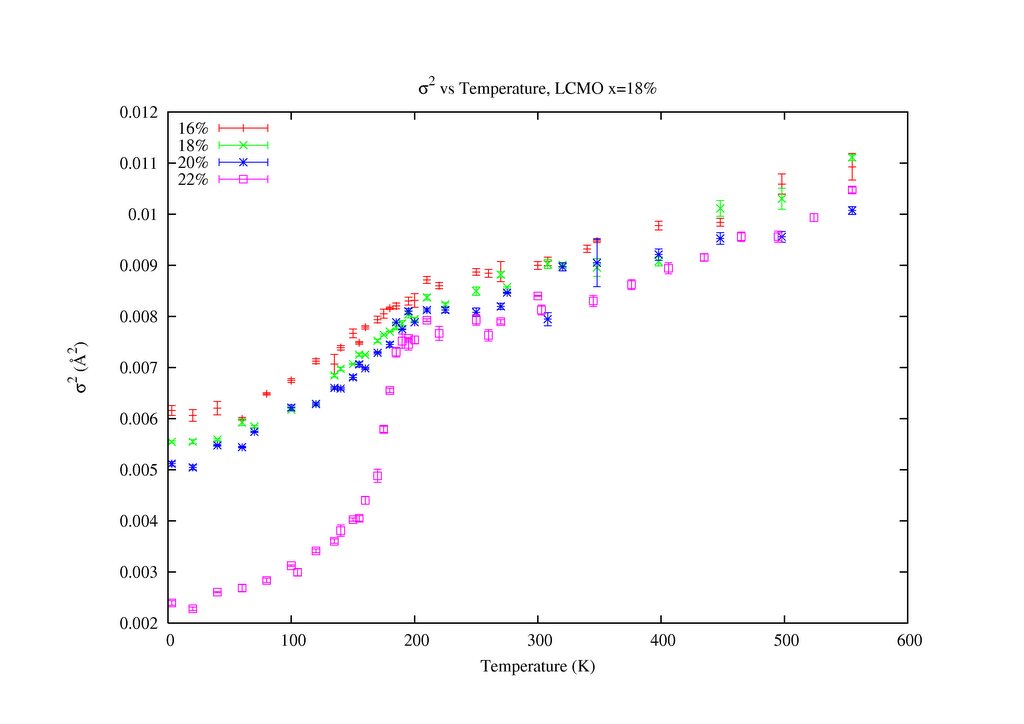
This is the Sigma^2 vs T for different samples with doping level x = 16%,18%,20%,22%.
A sharp increase in Sigma^2 (Sigma is the width of the Mn-O pair distribution function "PDF")near Tc.
The magnitude of the step decreases rapidly with decreasing x.
The value of Sigma^2 at low T is close to the value for zero-point motion for x = 22%, but increases substantially for lower x, which indicates that in the magnetized state there is either a large Jahn-Teller distortions or a static distortion which remains at low T.
The end compound LaMnO3 has a large J-T distortion, so we think it's caused by J-T distortion.

Also the magnetization at low T is small for lower x, indicating that not all of the sample is ferromagnetic, regions of antiferromagnetism may remain.
Monday, November 20, 2006
Mn-O standard for LCMO low doping samples and LSCO
I tried to use FEFF to calculate the Mn-O function from Norby's LaMnO3 and Poe*'s CaMnO3, and combine them with x = 0.2 to make a new standard, but failed. The XI and NX for them are different, so the computer can't just add them together. Tried with FEFF8.20 and FEFF6.
Then I tried to make the similar standard for Co-O, failed at the same problem.
Then I tried to make the similar standard for Co-O, failed at the same problem.
Subscribe to:
Posts (Atom)